Boatworks

  • Main
  • Louve
  • Typewriters
  • Workshop
  • Meritaten
  • Glypto
  • Motoko
  • Inspirations
  • About
9739841224.jpg

Winter 2018/19 renovation - summary

May 10, 2019 by Lukasz Kumanowski

Tonight we’ve lifted the mast from winter storage rack and I prepared it for stepping. Tomorrow early morning is the time slot for me with the crane.

Stepping the mast and rigging the boat is a milestone for me denoting that renovation season is over and we’re going into sailing season.

What has been done during this winter:

  • 3 new keel bolts

  • 1 new floor timber

  • new cockpit floor and structure

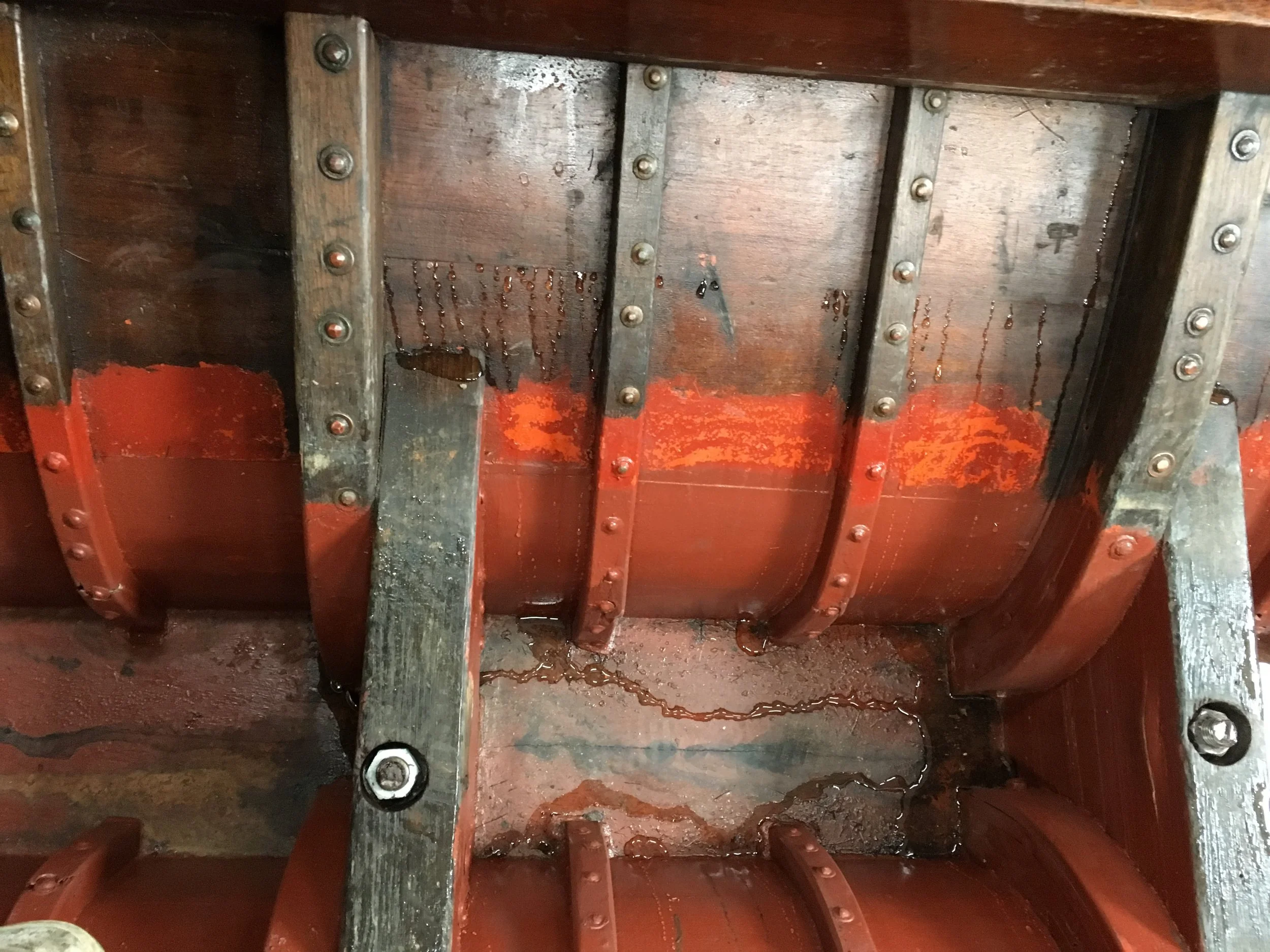
  • renovated engine compartment

  • repaired engine foundations

  • repaired 8 steamed frames

  • repaired 1 thick, glued frame

  • new mainsail traveller

  • new mainsail (from Sailservice in Gdansk, Poland)

  • engine renovation

  • new madrases

  • new cabin-cockpit wall

  • new sealing for cabin portlights, thru bolts

There are still some small things in the pipe, for which I already have hardware ready to be installed:

  • new deck hatch hinges

  • new cockpit locker hinges, sealers and locks

  • ship’s bell

  • nets for deck vents - to avoid last year adventures with wasp nest inside the boat (!)

  • third, emergency bilge pump

  • … and a few other things.

There is always something to do on a boat - if not sailing!

May 10, 2019 /Lukasz Kumanowski
Comment
IMG_6370.JPG

Sail traveller and other small jobs

May 10, 2019 by Lukasz Kumanowski

Last couple of nights I was finishing small jobs which remained to get Meritaten ready for sailing to summer harbour.

I’ve finished cabin floor around the new floor timber - oak supports and trimming old mahogany planks.

Most importantly - I have installed new mainsail traveller. It replaced ancient solution which I had - simple brass beam with very limited options for mainsail shape trimming.

The new traveller, as it is longer and spans across the cockpit - required making higher cross beam for mounting. The old beam, made of mahogany, is below cockpit benches’ tops. I’ve made a spacer beam, of oak, to equalise height difference. On top of that sits oak plank which serves as a base for new Barton traveller. The whole thing became a bit beefy which I see as an advantage - it reinforces the old beam below.

All oak components, after forming and sanding, got double layer of protective epoxy coating (WEST system). Later on I will also varnish them, together with the whole cockpit.

The top beam required some shaping due to collision with cockpit hatch. It took one hour to make and I’m pleased with the result.

IMG_6264.JPG
IMG_6265.JPG

On the dry run all parts were drilled for assembly. I used 100mm M6 stainless steel A4 bolts and nuts. They connect all beam components together and loop-nuts will serve as connection points for anchoring the traveller to the boat.

Upon installation all adjacent surfaces were taped, to simplify cleanup. I used Sika this time, the assembly will not be removed too often.

IMG_6365.JPG

Screws were also bedded in Sika, to inhibit water entry into the wooden beam.

IMG_6366.JPG

After installation the new traveller looks as if it was born with the boat. I chose Barton and not Selden or other brand as Barton was the only one with minimal amount of composite material used in the traveller. It is all anodised aluminium with Delrin ball bearings.

IMG_6367.JPG
IMG_6369.JPG

Tonight I rigged it with hemp-coloured steering 8mm rope and started making anchoring to the hull.

In the meantime I ordered service kit for sea-water pump for my Yanmar. Lidingö Marin was very quick - I got parts within one day!
Anyhow, I plan to mess with water pump after sailing to Norrtälje. I don’t want to prolong my stay in the boatyard and since I use the engine for few minutes only, when manoeuvring in the harbour, the leaking pump should not be the problem.

Meritaten is still not fully tight. The pump starts every 8-10 hours. I have a feeling that leaking increased since I started the engine and run it for 15 minutes, idling. It might be due to vibrations that planks, still not fully swelled, developed leaks on seems. Or it is these screws holding the engine foundation which leak - hard to tell since engine obstructs the view into bilge there.

I agreed with Anders that on Friday evening I will prepare the mast so that Saturday morning we can install the mast and rig Meritaten. Then I’ll start final preparation for sailing home - planned to happen on the next weekend.

May 10, 2019 /Lukasz Kumanowski
Comment
IMG_6337.JPG

Yanmar-san!

May 05, 2019 by Lukasz Kumanowski

It was a family day today so I could spend only few hours in the evening for working on Meritaten.

First thing I did was to put back the sprayhood. Since I still cannot locate leaks on cabin back-walls I want to protect them from rain with sprayhood. Besides - it gives me some privacy in busy boatyard.

Next I connected batteries to the engine circuit and “domestic” circuit. Bingo! The electricity is back - after I connected all wires around the engine. Indeed, Yanmar-san is an integral part of my boat - it is a ground plane for electrical wiring.

I’ve left my temporary bilge pump solution in place since today I waned to focus on engine only. Later I will re-instal my standard bilge pump.
Jim came by to check how I am going - he was already sailing Kaika today. That motivated me even more to finish this job and move on into sailing season.

The next thing was to solve the collision between my new cockpit structure and engine generator: mounting screw could not be inserted due to too wide cockpit beam. Some drilling and filing was needed and finally the 20cm long screw could be driven home.

IMG_6338.JPG

After tensioning grooved belt I noticed that there is too little clearance between the beam and generator wheel. Some more filing of oak and the problem was solved. Thanks god my boat is not made of steel…

I also changed a fuse for engine control circuit: there was a 8A glass pipe fuse sitting in rather fragile housing. I changed it to standard car-type flat 7.5A fuse in water-proof rubber housing.

Last hose was connected - for sea-water inlet into water pump - and I could open the sea cock. To my dismay I instantly saw water droplets coming from sea-water pump. Dammit! One more leak to fix - but I think I can leave it until I sail to home harbour. I don’t want to mess with that here, prolonging my stay in the slip.

After filling fresh-water system with glycol/water mixture, adjusting gearbox controls and checking all hoses I moved on to the last step: fuel lines bleeding.

If one wants to find information how to do it on Yanmar 1GM10 then trying to find it in the engine manual is fruitless. This book was apparently written by law department - lot’s of useless warnings and disclaimers and very little useful information. Drawings are few and bad. It surely was not written by any engineer.
I followed a procedure found on some other blog. It’s easy: there are just 3 places where one needs to bleed the circuit: fuel filter, fuel pump and injector. Takes about 5 minutes.

Once done I could finally crank the engine. Add it started instantly!

What a joy! I can finally leave the slip!

I checked the sea-water pump. It leaks quite substantially. It must be a gasket on the axis, I should have changed it when I was messing with the propeller.

Anyway - I can use the engine as it is now, just need to be sure that sea cock is closed after motoring and sea-water is wiped from oil pipe running below. This pipe rusted last year causing engine spit all oil. Now it is changed to copper pipe, painted for security.
I’ll see to it after I sail home.

What is left now is to instal new mainsail track and anchor it to the boat. Then we can rig her and start preparations for sailing!

IMG_6336.JPG
May 05, 2019 /Lukasz Kumanowski
Comment
IMG_6287.JPG

Swelling

May 04, 2019 by Lukasz Kumanowski

It’s 3 days after launching and Meritaten has almost stopped taking water. I checked today that it still increases in the bilge but at very slow rate so that the pump starts once only during the day. I hope that my repairs have improved the situation and she will become fully dry in the bilge after a week.

As a reference for next years I documented where the leaks occur during launching - and at what scale.

It turns out to be mostly amidships and under the cockpit. Today these leaks are mostly gone so the cause of slow increase in water level must be on the garboard plank.

View fullsize IMG_6281.JPG
View fullsize IMG_6282.JPG
View fullsize IMG_6283.JPG
View fullsize IMG_6284.JPG
View fullsize IMG_6285.JPG
View fullsize IMG_6286.JPG
View fullsize IMG_6280.JPG
May 04, 2019 /Lukasz Kumanowski
Comment
IMG_6333.JPG

Connecting engine

May 04, 2019 by Lukasz Kumanowski

Anders allowed me to stay in the slip until I fix my engine. I don’t want to stretch his offer so today I worked 6h to bring my Yanmar back to operation.

First thing was to drain the old fuel.
When I bought Meritaten the tank was almost full of diesel. During both seasons when I sailed her I hardly used 5 litres, topping up the tank before each winter (to avoid condensation and water in the fuel). Before each winter I was also adding anti-fouling liquid to the tank, to prevent any biological contaminations.

This year I’ve decided to drain all this old fuel, flush the system and start with fresh diesel.

I’ve drained the tank by disconnecting the hose after first-stage filter and placing it into container. Since it would took very long to drain this way I also sucked-out the fuel directly from fuel tank, using a huge syringe for changing oil. After removing circa 22 litres the tank was empty. The last 2 litres were dark and full of sediments.
This gives me a hint about tank capacity - estimated 25-30 litres.

I then took 1 litre of old but clean diesel and flushed it through the system.

The next step was to align the engine against the propeller shaft. Even though the shaft has a flexible coupling and engine sits on flexible pillows the initial misalignment was too big to accept.

IMG_6331.JPG

I levelled the engine using fours big nuts which sit on top of engine bed. Once both shafts were aligned I connected them - which was a bit of yoga gymnastics as this assembly sits deep down in the bilge.

Then I started connecting all hoses and wires. Photographs and labelling I did last year were precious. Anyhow - working in very confined space, with very little room for tools and in awkward positions has made this a hard job.
Not to mention that certain things need to be done in proper order - otherwise one must disconnect the previously connected components to connect something which is now obscured and not accessible.
I don’t need to mention how I know this, do I?

At the end of the day I have all hoses and wires connected. What remains is to adjust engine controls (gearbox mostly), pour new fuel, bleed fuel lines, add glycol to fresh-water cooling system and try to start the engine.
That is a plan for tomorrow.

May 04, 2019 /Lukasz Kumanowski
Comment
  • Newer
  • Older

Powered by Squarespace