Boatworks

  • Main
  • Louve
  • Typewriters
  • Workshop
  • Meritaten
  • Glypto
  • Motoko
  • Inspirations
  • About

Bulbous typewriter - Remington Quiet-Riter

October 29, 2023 by Lukasz Kumanowski

This fellow came from a good home - was certainly been cared for and used not too heavily. It was also lucky to be serviced by a proper mechanic - all screws are intact, no butchered slots and all alignment is spot-on. Moreover - it has a brand new platen! The rubber is fresh and springy, typing is silent and pleasant.

The only problem was dust and molded ribbon. Certainly the machine was put back into its case and forgotten for many years, stored in room temperature in a wardrobe, I suppose, not on cold attic. Good for her! No rust, no solidified grease, just dust.

Another minor issue was variable line spacing mechanism not working.

To keep her in tip-top shape I decided to transplant clean and fresh ribbon winding mechanism from a younger Quiet-Riter 11 which is my donor machine.

Removing ribbon winding mechanism is easy, only on left side one needs to unscrew pull-rod for backspacing. On younger machine this rod is formed to pass under but on older version it is just straight and is in the way. I marked amount of thread to be visible before unscrewing - for easier calibration afterwards.

Old spools were covered with ribbon rests and metal coating was damaged.

While at it I renewed type-arm rest. With fresh rubber it will be even quieter when slugs hit home position.

All body panels got proper cleaning and drying. Sound-proofing is in perfect shape and fresh so I leave it as is.

Mechanism dusted off, body panels clean - assembling back all pieces.

Serial number is found close to right ribbon spool, on the frame.

To remove the platen on newer Riter one just unscrews both knobs by twisting them, they screw out with partial axle on both sides and the platen can be lifted.

Not here. This older model still carries the old style construction, with platen axle being a full-length rod. But there is a twist: line-spacing ratchet de-coupling mechanism is operated by a separate rod which needs to be removed first, before the axle can be removed from the right side.

At least that’s how I done it. I wanted to check variable line spacing mechanism anyway.

The mechanism is simple: three toothed surfaces of the platen clutch engage with toothed band on the inside of platen’s left metal collar. Clutch engaged.

To disengage one presses-in left platen knob which pushes a short rod gliding inside platen axle which, in turn, pushes the clutch away from toothed surface. Clutch disengaged, line spacing becomes variable and permanently changed.

To assemble back the platen I inserted the axle from the right. Empty axle emerges from the left.

Insert the short rod into its channel…

… and rotate the axle by 90 degrees, to see surface for landing knob’s set screw.

This part is important, so that we don’t press the rod with set screw because it will block clutch mechanism. Which was exactly why it was not working when I got the machine.

With all assembled back together the machine was ready for work.

I much prefer this earlier version, with rounded, bulbous ribbon cover.

Newer versions have the logo made from plastic, here it is brushed metal. Nice detail.

Left side of the carriage houses most controls: carriage release, variable spacing with clutch release (platen knob) and without clutch release (thus non-permanent spacing alteration).

Three sets of line spacing: single, one & half and double line.

Being a 50-ties child the machine has a “car hood” instead of ribbon cover. Bi-chrome selector for red, blue and stencils on the right. Ribbon reverse lever on the left.

Speaking of cars and 50-ties, I had to compare this Remington with another bulbous machine from that era: Underwood.

Not as radical as Underwood, Remington is more toned down yet has a slightly bigger footprint.

Mugshots reveal that it is also a bit higher.

Both are handsome machines, Remington being less extravagant I suppose.

They were big competitors back in the day. Shouting on each other with wide-open hoods!

Typing on this Remington is very satisfying. The action is smooth and soft but not spongy. It is a silent machine. Basket-shift, ergonomic key-tops, well spaced keyboard - suites me very well.

Typing action reminds me one of another bulbous machine from that period - Hermes 3000. I agree with Ted Munk on that: typing out on this Remington is very comforting.

Hermes is, however, even bigger and wider!

“Bulbousness” in its best, with Hermes leading in sophistication of shape.

Remington not as extravagant or sophisticated but still very robust and comfortable tool for serious writing. And not an eyesore either!

October 29, 2023 /Lukasz Kumanowski
2 Comments

Gossen Tippa - office in a briefcase

October 22, 2023 by Lukasz Kumanowski

This little gem came to me dusty and dirty but in working condition. Mostly. One obvious problem was that backspace was not working. After removing the ribbon cover it became obvious that the key is not connected to anything - the lever was missing.

I started with fixing that. Eyeballing the most convenient way to lead the linkage gave a shape as follows.

Linking spring-loaded key lever, under the ribbon spool post and into 90 degree pulley. It works perfectly so I think the original was, more or less, the same.

Another problem was dried and damaged type-arm rest. It was made of rubber, glued in place. I don’t think this is how it was originally, I would rather expect felt. Anyway, this was not doing its job - slugs were landing with loud “clack” and some of them were hanging above it. New and thicker landing pad was needed.

I scraped the old rubber and removed all glue. The L-shaped rail has four holes which maybe were used to hold the pad in place. I decided to use them that way.

I cut a stripe of synthetic felt which will be sewn into a half-circle pipe, making it thick and sound-dampening.

Saw by hand - relaxing job!

I put that aside - it will be installed once the machine is clean.

Removing the platen is pretty standard: starting from the right knob which is held in place with two screws.

Unscrewing two screws close to ratchet wheel frees the platen rod which can be then extracted with the left knob.

On the right the platen has a thick shim/washer which fills the space for tight fit. Good to pay attention and not loose it. To extract the platen one needs to unscrew paper bale and paper table first - pretty straightforward with just two screws. Paper table is held with a spring (on the right side) which needs to be unhooked. I leave it hanging.

Feed rollers assembly comes out right away, held in place with just two positioning pins. On my machine the rollers were in perfect shape so I just clean them.

Line advance ratchet can be a pain on some machines so, to avoid headache upon re-assembly I keep all in place with a bolt, in absence of the platen rod.

Dusting-off and cleaning followed. Luckily this machine was saved from excess grease or WD40. It had lots of stains, thou, which were sitting hard on crinkle-painted panels. With some surface-active chemistry I managed to clean them without damaging crinkled surface.

Dents and oxidized surface of the platen got sanded away on a lathe and cleaned.

Time to assemble all back. First comes new landing pad for type slugs. Mounted in place with black string through holes in the rail.

Rubber feet were gone - hard as plastic and flat as pancakes.

Unscrewed and pried out.

I made new ones - Biltema’s rubber set came to help, as usual.

I managed to disintegrate line advance mechanism upon re-assembly. It gave me a bit of headache to put it back together properly so here comes detailed pictures for anyone having the same problem.

With platen back in place I installed an old ribbon - to test type alignment. With faint imprint it is easier to see if cylinder needs adjustments. On my machine it was clear that it does need it.

I started with lower letters position. Adjustments screws are on both sides of the carriage.

For capitals there are similar screws on the back of the machine, both sides. Thin screwdriver is needed to access them through small openings in frame’s back panel.

Easy yet a bit frustrating process - after several repetitions I finally managed to get decent imprint and level for both capitals and small letters.

Next came additional adjustment: line level across the whole length of the platen. Done!

Lastly shift-lock position was adjusted. Tippa is a proper machine - it has adjustments screws for that so no need to bend metal (sorry: “to form metal”!).

Test-typing with old ribbon show nice, equal imprint. Time to install new ribbon and screw back the bottom plate. Last look onto the frame and easily accessible escapement.

And so she is done!

Tiny typer, much lower than matchbox!

;-)

Well, not really. Depends on matches but “benchmark” matchbox is of the same height as the machine. She is flat!

All panels are made of aluminum so the machine is lightweight. Not as light as its younger incarnation I fixed before but much lighter than Groma Kollibri.

Paper support /wi-fi antenna swings from the back.

Slick and very “technical” design. Left side features even touch control - two positions.

Back panel with dealer plate and factory logo. Aluminum, screwed in place.

Right side with ribbon wind/manual reverse knob. Automatic ribbon reverse is present, of course.

I like these small design details: here the line advance lever in erected position.

After engaging carriage lock the lever is folded down into storage position.

I would call this design “utilitarian”: there is nothing here which is just for beauty, all has its purpose. Triangles on both sides, with textured surface, are here to enable lifting the machine from table. She is so flat that there is really no other place for grabbing her.

Tiny and unobtrusive logo on the right - that’s the only ornament this machine bears.

She reminds me of other German machine of that era, equally flat and utilitarian.

Tippa has slightly bigger footprint due to its wide base-plate.

But both machines are super-flat ultraportables.

To be fair I should add that Groma Gromina should be used with its wooden base, she is not made to be detached from it. I added small rubber feet to Gromina to be able to use her without it but lap-typing is not advised while Tippa is very well suited to that, with its base fully covering the mechanism.

How is she then compared to younger cousin Groma Kollibri?

One can clearly see the spartan approach in Tippa, compared to curvy and flashy Kollibri but size-wise they are in the same league.

My machine came with its aluminum cover and leather suitcase.

Closed machine hides in the main compartment leaving place for necessary office utensils in the second compartment.

At first I thought that this is faux (artificial) leather, with these deep patterns embossed on it but upon closer inspection I think that this is indeed real leather. It ages like one and feels, too. I don’t think they had technology in 50-ties to make artificial leather so much resembling real one as we have today. And the case is surely original from 1955-ish.

Great article about Gossen Tippas by Robert can be found on his blog.

A scan of the original manual to the machine is available from Richard Polt’s web page.

So how does she type?
She types very well!

Compared to Groma Kollibri - much better!

Compared to Groma Gromina? Equally well, maybe a bit nicer. '

Compared to Antares Parva?
No, Parva is still my best ultraportable, Tippa being very close on the second place now.

October 22, 2023 /Lukasz Kumanowski
Comment

Remington Rand 5 with rotten keys. Fallout machine.

August 30, 2023 by Lukasz Kumanowski

This was one of my “parts machine”. It had ugly, damaged and rusted keys and lacked parts which I picked for fixing other machine. Body panels, originally in crinkled black, were ugly repainted at some point. I planned to dismantle the machine into screws and spare parts and throw the rest.
But there was some life in her and, more importantly, typeface is in Elite-size. I decided to give her a chance.

First I needed to remove the paint. That went quickly, with heavy chemistry and a few days of soaking in plastic bags.

I like this bare-metal look. Streamlined body looks nice in silver, a bit like Airstream.

Keys then.
There were no signs of corrosion in the whole machine apart from keys. Key legends were delaminated and sticking out of key rings. I suspect that someone cleaned the machine with water at some point. It got soaked into cardboard key-legends and stayed there for years, doing its nasty job.

I don’t have a dedicated tool for removing key rings so I made my own: converted nail lifter (ugh!). It is a bit finicky to use but it did the job alright and costed me 10 dollars plus some effort to re-work it.

With key-legends removed the scale of damage could be assessed.

Definitely job for Evaporust. At first I dispensed it only into key cups, hoping that a few hours soaking will dissolve the rust.

It didn’t so I doped the whole keyboard and left it for a few days.

That did the trick: keys emerged with no trace of rust.

I punched new legends from synthetic cork. It is water resistant and offers a bit of cushioning for fingers.

My plan was to cover the cork with printed key legends in classic style: black letters on white paper. However - why not leave the cork visible? Will it not add a bit of organic warmth to this otherwise cold-steel machine?
I took her out into sunlight to decide.

Ain’t bad, no? A bit MadMax style. Or Fallout maybe?
OK, so let’s make key legends in a bit unusual typeface, to go with this sci-fi theme.
I printed them, in mirrored direction, on OHP-foil. This way the plastic is protecting printed letters from being wiped during typing.

Key rings, cleaned and polished, were easy to press back into their place. I used a set of parallel pliers and thin wooden stick to protect the rings.

And so it became quite a sexy machine! I made new springs in place of these which were missing, fixed problems with the mechanics, cleaned and oiled the mechanism and she types again.

It looks that we have a survivor!

August 30, 2023 /Lukasz Kumanowski
2 Comments

Simon techno typeface for Blickensderfer

April 16, 2023 by Lukasz Kumanowski

Now that is a little perverse: implementing ultra-modern, science-fiction inspired typeface for ancient, manual typewriter. Ain’t it?

But why not?
I am a big fan of Simon Stålenhag. Really good, hard science-fiction.
In one of his albums there is a line showing an old computer printout. I fell in love with this typeface! How about implementing it on Blick?
It is just two sentences so not the whole alphabet is used. I had to draw remaining letters to match the esthetics.

At first I thought it is a typeface used in Alien series. Nope.
OK, then maybe Blade Runner? Nope.
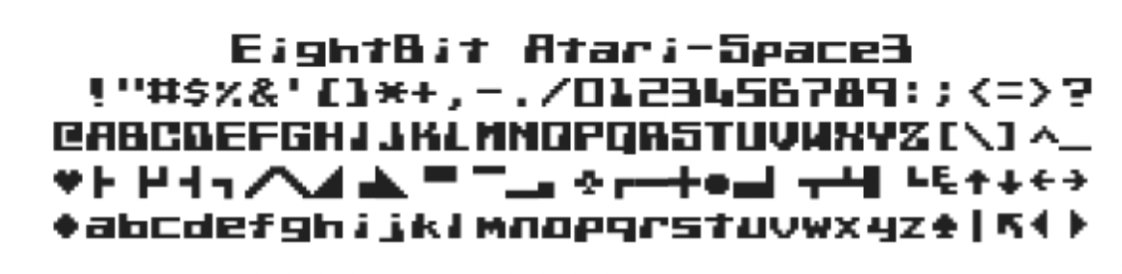
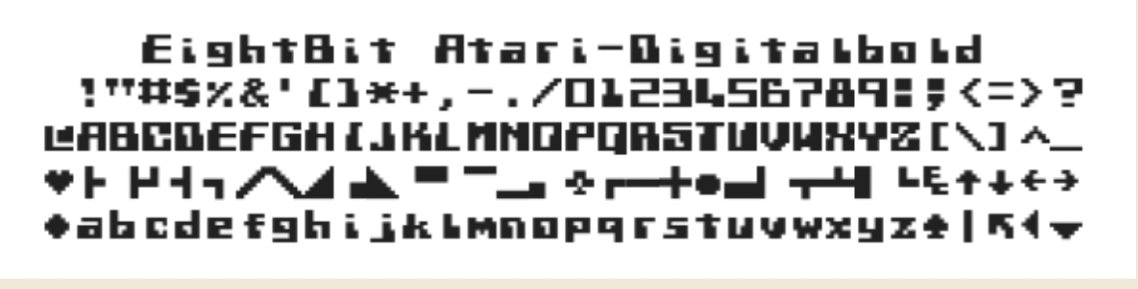
So Amiga or Atari? Well, also “nope” but that led me to super inspiring website driven by enthusiast who preserves old Atari typefaces: https://atari8bit.net/projects/artwork/atari-fonts/

I’ve contacted Steve and he kindly allowed me to post a few screenshots of these fonts. These were ones I used to draw my typeface, to resemble the one used by Simon Stålenhag in his book.

View fullsize IMG_7490.jpg
View fullsize IMG_7491.jpg
View fullsize IMG_7493.jpg
View fullsize IMG_7494.jpg
View fullsize IMG_7495.jpg

I chose these which have a “serif” - dark pixel - at the base of a letter. They are not exactly as in Simon’s book but resemble it well enough to be helpful in my project. Besides - as these are available for download on Steve’s page - I may implement them as well!

I’ve called my typeface Simon techno. It took a few implementations to nail it, below is one almost finished - with some mistakes in number 7 and too narrow space between letters.

With final corrections there it is, with slightly thicker letters, a bit more spaced from each other and with R made differently from Simon’s, to distinguish it more from letter A when printed on Blick:

As I was feeling playful I made an opposite version - stencils - of this typeface. Kind of playing with my previous struggles to get rid of artifacts around letters. This one is all but artefacts, with letter not printed:

Well, obviously a partial success. It is too difficult to read and requires really heavy inking. What inspired me was -again - a branch of such fonts on Steve’s page:

So what is next?
Well, one of Atari typefaces for sure!

April 16, 2023 /Lukasz Kumanowski
1 Comment

Under wood. Underwood?

April 16, 2023 by Lukasz Kumanowski

Very busy weekend - we are already preparing for the next winter, stapling wood in the barn.
It was a hard winter this year and it may get even worse the next winter - given state of things in the world. It frees my mind to have this done already now, when weather is mild, no mosquitos and flies yet.
It took us 2 days to fill the place with birch wood. Almost done, a few cubic meters more in coming weeks. I must have been very tired because I constantly thought of myself as “under wood”. Which brought me an idea for a small photo session.

I know it’s a bit childish but… hell, all reasons are good to bring out this beauty and admire its lines!

April 16, 2023 /Lukasz Kumanowski
Comment

Harrington Mk7 - modified type element for Blickensderfer 5

April 09, 2023 by Lukasz Kumanowski

Winter is unwilling to let go this year but today we got a sunny day.

I was modifying Harrington typeface to match my 3D printing process. Letters became bold, to get better margins with direct inking technique used on Blicks. This typeface is very delicate but proportional and is otherwise very suitable for Blickensderfer.

The result is good. Finally!
With felt ink pad and oil-based ink the imprint is of reasonable quality. I’m not sure I can get it any better.

There will be one more iteration before I consider it done: I will replace fractions with Swedish and maybe Polish letters. Although I finally managed to implement fractions with this Mk7 version - I don’t really use them! And I lack Swedish letters when typing a letter. Having them at hand will make the type element more suitable for my use.

So there will be Mark 8, most probably the final revision!

April 09, 2023 /Lukasz Kumanowski
Comment

Underwood Finger Flite Universal. Fifties esthetics at its best.

April 02, 2023 by Lukasz Kumanowski

Not exactly rare machine, quite the opposite, but a great looker and magnificent typewriter. Basket-shift machine, no-nonsense operation, very light and snappy touch. Moreover - very easy to service, I dare to claim that Underwood engineers were thinking about servicemen when they designed this machine.

My specimen was just dirty. Very dirty but still working fine. It also had type bar broken but luckily it was still attached to the machine.

The usual procedure - stripping down to bare bones for cleaning and inspection. Body panels are kept with just a few screws. To remove the front and side panel one needs to unscrew ribbon-wind/manual reverse knob.

It is a left-hand thread.

Right-hand platen knob goes out after loosening the set screw.

Left-hand knob has its set screw hidden longer inside the axis.

Pulling it out, like for de-coupling the platen line spacing ratchet, reveals the screw.

To gain more place for platen removal I removed the paper table. Loosening locking nut and backing the set screw unhooks the table from its pivot.

As the table was not sitting exactly in the center I adjusted the similar screw on the other side.

Now comes the platen. It sits tight and paper-release lever is in the way.

Just take the lever up - paper release position - and you get a clearance.

On the left side the platen is still held by its axis. It cannot be removed while the platen sits in the carriage so just press it into the platen. After the platen is out it can be pulled out with pliers or pushed out with the platen knob from the other side.

Extracted from the platen the axis shows clutch release cone.

The platen was in good shape but bearing marks of frequent use. I sand it smooth and clean the oxidized rubber.

Paper deflector is in excellent shape - no rust, no dirt either. It is hanged with similar pivoting concept as the paper table.

You don’t have to remove it to inspect and pull out paper rollers. Just lift it and swing out of way. Servicemen-friendly approach.

I remove it anyway, for better access for cleaning. Loosening one screw, on the right side of the carriage, frees the component.

Service-side of the carriage - with line advance and ratchet pressure roller - nothing flies away in absence of the platen. All sits secured. Again - servicemen in mind: easy to clean and to repair.

Serial number on the rail of the carriage, right side.

Machine ready for cleaning. It was enough to brush it and blowing dust with compressed air. Remaining, accessible dirt cleaned with stick-pads.

Spacebar is made of Bakelite. It bears traces of unsuccessful gluing. Looks like a glue to bond rubber, no wonder it did not hold long.

I considered my options. I could use this piece to make a new key. To match a burgundy color I could carve it from mahogany.
Or I can try to salvage the original key. Worth trying, always better with original parts - and this one is a sign of really brutal excitement!

I clean all rests of the old glue.

Tedious job but necessary to provide reliable surface for epoxy. I used fast curing semi-transparent epoxy. Left excess until partial curing, I will cut it once half-cured and sand the rest after full cure.

While this was left to cure I clean body panels. I use sunny weather to dry them on car roof.

Type slugs cleaned.

So why was the spacebar broken? One reason may be that the owner - or repairmen - installed too thick rubber bumpers on the bottom tabs. There was not enough space for them, spacebar could not be pressed down enough to trigger escapement. To “fix” the problem someone bent the bottom of the panel, to gain 1-2 mm room. All that instead of simply replacing these rubber rings with something a bit smaller.

Fixed that by replacing them with thinner, silicone tubing. Bottom panel straightened back to original shape.

With the mechanism cleaned, platen sanded and cleaned I assemble all back together. Straightforward process. To install the platen it is best to press the axle all the way into the platen. It will be pushed out after installing the right-hand platen knob so no worries.

Original ribbon was at its life-end so I wind a new one: cotton!

This machine needs to have rivets - or any kind of hinder - on the ribbon, to trigger ribbon reverse mechanism. Neat solution with document binder pins:

View fullsize IMG_7501.jpg
View fullsize IMG_7502.jpg

Done!

So finally - type test!

Time for photo session. Lines of this machine remind me Buick Super from the 50s.

Even ribbon cover opens like a car hood.

What’s under the hood? Type strength regulator, of course!

Decals on this machine are in pristine shape.

Ribbon color selector is also a decal.

Underwood emblem is in painted metal, a few chips in paint reveal yellowish metal surface.

I’m glad that I saved the original spacebar. It shows clearly that it was repaired but functions perfectly and bears sign of events full of anger (I think).

I added epoxy fillet underneath. It adds lots of strength and is only visible when the machine is up-side-down.

Fantastic machine indeed!

April 02, 2023 /Lukasz Kumanowski
6 Comments

Everest Mod 90. Italian beauty.

March 30, 2023 by Lukasz Kumanowski

I used to trust commercial auction houses to describe objects professionally. Accompanying photographs are always detailed and show all scratches or wear&tear of sold objects.

This machine came to me from one such auction house in Sweden. Nobody else was bidding so the price was reasonable. It was a few years ago, thou. When I finally received mail with the machine I was very excited: the form, color, emblems - I like everything about this model. Will it type equally good as it looks? I wanted to try.
Nothing in the description nor photographs suggested this.

I checked again pictures accompanying the auction but there was no trace of this. You cannot miss these cracks and dents in keys, even if you know nothing about typewriters. The photographs were made in a way to mask this, with proper lighting!

Well, you learn all the time. To send back this machine would cost me too much to be worth it. I wrote to the auction house complaining about the condition but I was ignored. Fine, no more purchases from Kalmar auction house. Ever.

The machine went to storage and I forgot about her. I was too angry to even start working on her. Only recently, when “venting” the collection I stumbled upon her. What a beautiful machine!
Time to do something about it - how does she type?

Oh, she types beautifully! She came with carbon ribbon, type slugs were clean and Elite-size typeface was perfectly aligned and crisp on paper. The action is smooth and snappy, no marshmallows!

After typing a few pages I decided it’s time to take care of her. She is worth saving.

List of problems was short:

  • dust everywhere but luckily no excess oil or WD40 - all was moving smoothly

  • damaged keys

  • a bit “clunky” sound of spacebar and rather noisy action. Needs better sound isolation

  • line advance mechanism was not working

I considered options for repairing the keyboard. One could be to 3D-print new keys. And while doing totally new ones I could make them with metal rings and glass tops. Original keys could be used for repairing other machines - I have a few with missing keys.

I removed one key and started sanding it, to get rid off legend. I wanted to use it as Shift key on another machine.

But then I stopped, looking on half-done key: the scratches disappeared, sanded away, and the legend was still there, nice and clear. What if I just sand these keys, to satin finish, and keep them as originally on the machine? It will suit her much better than “prosthetic” keyboard I wanted to make.

That seemed to be a way forward. Instead of fixing this other machine (with missing Shift) I took Everest on the bench. At last!

Removing panels and ribbon cover (car-hood style) is pretty straightforward, with a couple of screws on sides. No screws holding them at the bottom of the machine.
The back panel is a part of the frame - spacebar escapement trip and ribbon vibrator/color selector are anchored there.

One can leave it on and still clean the machine - access from the bottom is good - but I wanted to add sound isolation there so it had to be removed.

This machine most probably was never serviced. All screws, even the smallest, are in pristine condition. No butchered heads. What a joy!

Platen removal is straightforward but there is a catch to it.

First goes platen knob. On this machine it is enough to unscrew the right one. The screw is centric to the shaft.

At the very base sits a thin shim or washer, acting as a support for compression spring.

After removing platen knob one needs to unscrew one (only!) screw holding the shaft.

Unlike on all other machines I worked on - this is not a set-screw and it needs to be removed entirely. In my case it was not possible - platen’s rubber was overhanging the screw head and it could not be entirely backed. The shaft was sitting rock-solid. I had to shear the screw to remove the shaft!

It turns out that this screw is entering the shaft all the way thru and it is the shaft, not platen, which is threaded. That’s how they manage to keep the shaft well connected to platen with only one screw.

With platen removed I could dive deeper into carriage guts.

To save me trouble at re-assembly I secure line advance ratchet and surrounding mechanism with a temporary screw.

While looking at this I noticed why the line advance mechanism was not working: the tab got bent and was sitting outside of space setting arm. Formed it back into shape - it should sit as on picture below.

Paper table and deflector create one assembly. To remove it from the carriage one needs to unscrew one screw, on the right side.

This removes one bracket and the table can be moved out from the other, on the left. But before - detach two hard springs on the back.

And voila! Paper feed rollers accessible for inspection.

Last body panels to remove - ribbon bowls. Each is held by just one screw, running through a spacer below.

Stripped from panels the machine gives good access to internal mechanism. Down to my de-dusting station: big dust got brushed away, rests blown out with compressed air.

Paper rollers were in excellent condition but very dirty, with rests of TipEx and other dirt. Chemical cleaning brought them back to shape.(attention: product placement!)

Body panels have some sound isolation but it is just thick cardboard. I will replace them with felt.

Next I remove keys. All will be sanded and polished to satin finish.

One key got too much chipping to be good enough for just sanding. I need to rebuild the top part of it. JB-welding should take care of that.

I left it for two days to fully cure.

Shaped with sanding paper and painted looks almost like it never happened.

Once all keys got their satin finish I could put them back onto the machine. At last!

I decided to re-coat the platen. It was not damaged - no chipping nor cracks but it was hard and slippery, not taking paper well enough. I used two layers of thick, double-walled heat shrink tubing. But first the platen needs to be turned down on a lathe, to accommodate these new layers.

Original diameter recorded.

Heat shrink tube, depending on amount of shrinkage, will become thicker. Which is logical - the material does not disappear, just shrinks. I removed nominal thickness for two layers of tubing, to have a bit of excess material for final turn on a lathe.

Platen ends got excess rubber removed so that set screw could be now installed/removed with ease. No need to shear the screw to remove the platen now.

I had to fix this sheared screw which parts were still sitting inside central rod.

Since this is a thru-hole it went smooth.

I don’t have set screws matching the existing thread (whatever it is but it’s not metric) so I re-tapped it for M2.5.

All ready for assembly.

Last thing to do - new ribbon. Spools on this machine have slightly smaller diameter than universal spools.

Ribbon rewinding is easy here - the machine is equipped with “universal ribbon winding port” on each side.

All right, so how does she type now?

Well, she types like a dream!

It’s end of March so the snow is still everywhere. Right environment for Everest photo session.

Venting the engine…

According to Typewriter Database this machine was produced around 1951. Decorations, however, have the look of earlier era, classic pre-War esthetics.

Yes, she is a looker. And typer, for sure.

Post scriptum: glass key variant!

I was lucky enough to find another such Everest in more standard, glass-key version.
The key action is very similar to the one above but this machine was apparently renovated at some point.
She has a new platen - “new” being somewhere like 30 years ago that is. The rubber is still elastic and paper feed rollers are in perfect condition.

She must have had a carrying owner - all I needed to do was to dust off the mechanism a bit and treat body panels with Fulgentine, to bring back the shine and deep, green color.
Boy - is this machine not pretty?!

View fullsize IMG_5745.jpg
View fullsize IMG_5746.jpg
View fullsize IMG_5748.jpg
View fullsize IMG_5749.jpg
View fullsize IMG_5750.jpg
View fullsize IMG_5751.jpg
View fullsize IMG_5752.jpg
View fullsize IMG_5753.jpg
March 30, 2023 /Lukasz Kumanowski
Comment

Harrington - new type element for Blick

March 20, 2023 by Lukasz Kumanowski

I was looking for a type face which will be interesting, ornamental and easy to read. And possible to implement on Blick. Harrington caught my eye but initial attempts to print it were unsuccessful. Mostly due to letters breaking during layer detach and eroding. Especially delicate serifs. And this typeface is all about serifs!

The typeface is balanced and proportional so very suitable for Blick.
To reinforce it - while not making it bold - I used the same concept as used on traditional, metal slugs: I reinforced serifs with separate extrusions, formed with chamfers to not interfere with imprint.

It took a while to adjust the model but seemed to be worth it. I printed the cylinder over the night. I chose no anti-aliasing - to keep delicate details intact.

I still use my home-made ink, while waiting for delivery of oil-based stamp ink, so inking is very rudimentary but first test type is looking promising!

I type on very thin paper, without any backing sheet, on stone-hard platen. This is to clearly see if alignment is correct. And it’s not - capitals are only partially printed, small letters are darker at the bottom.

My platen is at its closest position (cylinder adjustment) so no way to move it closer and imprint suggests that. So there will be next iteration, with type face shifted a millimeter or so, to match the platen. I don’t want to change other adjustments on the machine - she is adjusted for original type element and needs to stay like that.

So the story continues…

March 20, 2023 /Lukasz Kumanowski
1 Comment

Messing up with Blick - second cork platen, new type elements

March 18, 2023 by Lukasz Kumanowski

This time I took care to make the platen concentric. In the same style as original I made two separate axle pins, to be pressed-in and glued on both platen ends.

In my favorite typewriter-supply shop I bought thinner cork composite, just 1.5 mm. Turned the dowel accordingly.

With thin cork I skipped cutting 45 degrees overlap. Gluing went quicker that way and the effect is very good. Glue line is hardly visible.

It looks cool on Blick.

So did it make a difference compared to the old, hard platen?

Well, it did but on the wrong side, again.
Even so thin cork is too soft, letters dive into it deep enough to leave artifacts around, resulting in dirty imprint.

It’s never too late to give up but I decided to try a few more ideas before I dump this path.

To recap:
- I made a new platen to improve imprint from my custom type elements. With a bit more elastic platen hope was that “stamping” will work better.
- Elastic platen should also protect type element from premature wear. After all - it is plastic.

So the remaining problem is that type slugs dive too deep into the platen so that surrounding face of the slug is also printed.

  • How about reducing this surrounding area?

One of my original cylinders has these grooves separating each facet. I printed a new version, with Bernard typeface.

Did that do the trick?
No. A little better but not a revolution.

OK, so maybe I increase the height of these slugs?
Originally I made them stick out 0.5mm. If I increase extrusion to 0.7mm, will it print properly? And will that be possible to 3D print?

I tried.
It did 3D print OK, no problems here. But the imprint was only slightly better.
Small steps all the time.

I chatted with Leonard Chau who successfully printed many of these. He seems to print as high as 1mm type slugs, with additional curvature on them, to match platen curvature.

Well, let’s try that!
I increased extrusions on my CAD model and then cut them with platen profile.

As a result each type slug has a slight curvature on its face.

Very excited I run a batch of three cylinders, with Bernard, Fraktur and Harrington.

Harrington typeface prove to be too delicate for such high extrusion, some letters did not print completely. With Fraktur and Bernard all went fine.

So - did that finally made a trick?
No.

It turned out that this introduced curvature made the imprint even worse. It became very sensitive to cylinder (platen) position relative to the type element. It became too tricky to calibrate.

Moreover - with so high type slugs they became very susceptible to damage.

So I fall back to original platen and lower extrusions. I went through all my typing elements with different designs and selected these which work the best. They will be a benchmark for developing this further.

So far my most successful implementation is Fraktur: SW Gothe. It is very ornamental so difficult to read.

Nothing to type long letters to anyone we care about.
But if you don’t want them to answer - yeah, Fraktur is a way to go.

As for a casual typeface - one to be used for letter writing etc - I pause my work with Bernard. It seems to be too condensed and prints poorly on Blick.

I will instead focus on Harrington. It should be easy to read and at the same time it has intriguing features with its serifs. I will just need to make it more substantial for darker imprint.

But that most probably is dependent on ink, too. It’s obvious my inking has a lot to desire.

Chatting with Leonard we came to conclusion that oil-based ink can be an option. Hard to find these days as most applications switched to water-based inks. Water inks are not corrosive and do not deteriorate rubber.

But this is not concern for me as I make my cylinders from epoxy.
I’ll just need to take care not using original Blickensderfer cylinders with that ink.
They are made of rubber.

To be continued…

March 18, 2023 /Lukasz Kumanowski
Comment
  • Newer
  • Older

Powered by Squarespace