Boatworks

  • Main
  • Louve
  • Typewriters
  • Workshop
  • Meritaten
  • Glypto
  • Motoko
  • Inspirations
  • About

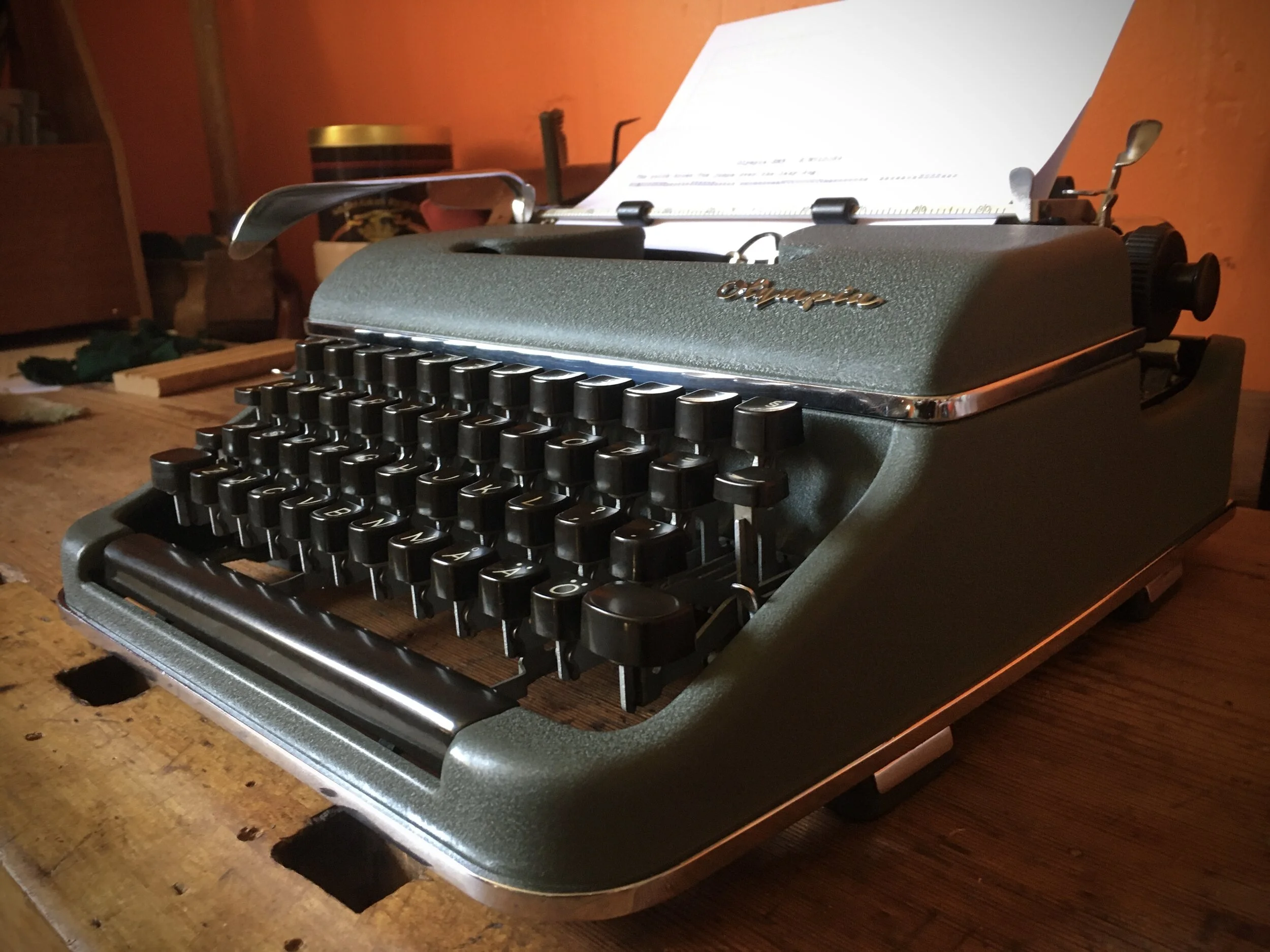
Olympia SM2

May 14, 2021 by Lukasz Kumanowski

This old, German machine had no serious problems. It just needed CLA and replacement of few rubber parts.Most typewriters on the market really need only that - cleaning, very moderate lubrication and alignment. They were build to last and withstand years of heavy beating. Unlike computers or mobile phones…

The main issue was that carriage assembly was scrubbing body panels on the sides. It is a common issue with these machines and is caused by rubber cushions being compress to much or decomposed due to age. Most owners do not recognise that there is a problem until the carriage does not want to move any more and side panels have deep, ugly dent. This machine, luckily, was not used when the problem occured. Side panels have just a bare sign that the carriage got too close.

The second issue was misaligned position for capital letters. Easy to fix.

I started by cleaning disassembled machine, to blow away all dust and dirt accumulated through the years. Font bars of few letters were a bit stuck so chemical degreasing of the whole basket was needed. Keyboard and platen covered with rags, to protect them from nasty chemicals.

Font slugs were dirty, filled with dried ink.

Cleaned that - now they look properly and leave clear, crispy imprint.

Keys were a bit grouse and dirty but suffered no damage. They are chocolate-brown, matching nicely sea-foam green body.

Luckily this machine was not treated with WD-40 or similar pseudo-oil. There are many folks who believe that this is lubricating oil. It’s not. WD stands for water displacement and it does exactly that. After a while it hardens and solidifies. If precise mechanism is sprayed with WD-40 it will work for a while but then it will stall!

Someone attemped service on this machine and greased most part of the mechanism with thick lithium grease. I needed to remove all that - even though it does not stall the mechanism it accumulates dirt and will cause problems. These portable typewriters really should be dry. There are only few places where a drop of thin, machine oil (literally, very small drop) is needed. Otherwise - no lubrication!

To get inside the basket I lift type bars with a rag. Spraying solvent onto the mechanism and blowing all gunk out with compressed air.

I then attended aligning the carriage, starting with small letters. Olympia SM2 is a carriage-shift machine meaning that to get capital letters one lifts the carriage. More modern machines have mostly segment (basket) shift meaning that the heavy carriage stays in the same place and font slugs are adjusted up and down instead. As the segment is lighter than the carriage such machines are usually quicker and easier to write on. Some refined machines with carriage shift can perform equally well, carriage shift is assisted by spring mechanisms.

Regardless of the construction the goal is to get the best imprint by aligning the assembly so that font slug lands on the proper part of the platen’s curvature.

It is an iterative process. This machine has adjustments screws on both side, accessible after body panels are removed. We start with small letters, aiming for even imprint on both upper and lower part of the letter.

Screw for small letters adjustment visible in the frame opening

Once happy with the result we move to capital letters adjustment. This is controlled by screw positioned close to ribbon holders. Again, both sides need to be adjusted on Olympia.

Each adjustment is checked by typing test, until we have capitals aligned and good quality imprint. I use old ribbon for that - new ribbon, with its abundance of ink, will not show clearly enough if the font has weaker imprint on one side.
Several iterations later the adjustment was finished.

Carriage supports can now be slid into place and tightened.

View fullsize IMG_2291.jpg
View fullsize IMG_2290.jpg

After last adjustment - for Caps Lock - the machine was ready to get her body panels.

These got proper cleaning. Felt sound dampening was blown from dust and dirt. Metal panels got proper scrubbing and cleaning and were drying in the sun before assembly. WD-40 applied on their surface removed humidity rests and added some gloss to this crinkled, green paint.

Rubber cushions were flattened and almost decomposed. I’ve made new ones, circa 5 mm thick, from rubber pressure hose.

They are installed on shoulder screws, with corresponding washer.

With panels installed I check “under the hood” if nothing was missed or left inside the mechanism.

Typing test follows.

Ready for service for another 50 years!

View fullsize IMG_2311.jpg
View fullsize IMG_2312.jpg
View fullsize IMG_2314.jpg
May 14, 2021 /Lukasz Kumanowski
2 Comments

Typewriter's pad

May 08, 2021 by Lukasz Kumanowski

It seams not important but a pad dampening typewriter’s noise and vibrations is crucial for peaceful coexistence between the typist and the world around. Especially in public places or in your own kitchen in the evening. Not once was I asked to finish because family was going to sleep.

It can be whatever, just so that it dampens vibrations and noise. There are fancy pads on Etsy which can cost more than a typewriter. I decided to make my own, from scrap pieces of foam and yoga mat.

As simple as it looks: a piece of yoga mat (very soft and spongy) sandwiched between rubberised foam. I like rounded corners so I trimmed them with sharp blade.

Some finishing with sanding blocks so that all three layers blend into common edge.

As a trim and personalisation I added metal plates on each edge. Just for fun. I use old Dymo index-machine from 70’. I discovered by accident that Dymo with steel letter matrix can stamp also on stainless steel and aluminium tapes. There is of course brand new version of this machine, dedicated for metal stamping but it costs a fortune. The one I have I picked from thrift store for peanuts.

Aluminium is easier to work with so I reserve steel only to outdoor projects.

First test. Machine sitting on the pad is Remington Noiseless Portable.

It is indeed almost totally silent while typing now!

Perfect combo for late night consciousness streaming onto paper.

May 08, 2021 /Lukasz Kumanowski
2 Comments

Machine guns: Hermes 2000

April 24, 2021 by Lukasz Kumanowski

This is where my quest for perfect typewriter ended. At least for now.

It started very crazy: I promised to myself (and the family) that I’ll buy no more machines. I already have too many. To cut temptation I stopped looking on Tradera or Blocket. I thought I was safe.

What I forgot is that once upon a time, in my kerosene lantern madness, I registered my mail on auction website. They are kind enough to send solitary emails from time to time. It’s mostly furniture and some antik stuff - I like to browse through that occasionally. So I got one of these mails and, unaware of the danger, I opened it and… saw these two machines on auction…

The seed was planted (yet again!) and nobody was bidding so… I placed my bid. Pocket money indeed.

And I won both auctions.

Next step: shipping.
It came out that, even though both machines were at the same auction house, I have to pay for separate shipping and that it will take 2 weeks, at least, to get them here. Not to mention that shipment price was much higher than won value.

But that was not my biggest concern. I realised that kind people selling them did not care much if the machines will arrive intact. Of course they will pack them in bubble plastic and stuff but they have no idea how to protect the mechanism from damage when the package is dropped from the track. And we all know that they will be dropped several times, don’t we?

Typewriters today are mostly considered as decoration so if they arrive in one piece most people are happy. In my case I will use them so I won’t be happy getting them with broken escapement or so.
I have two Hermes Rocket/Baby ultraportables. They are beautiful pieces of precise engineering. And with that comes (relative) fragility. These Hermes 2000 are portables so bigger and heavier than ultraportables. Mechanical shock when they drop will definitely destroy or misalign the internals if not properly secured.

So I decided to pick them myself. After all it’s just 850km trip so why not?

I took a day off, jump into the car and hit the road. Destination: Oskarshamn.

It is not much to see in Oskarshamn, apart from sea cost and nuclear power plant. Nothing which would justify 850km drive. Apart from two Swiss-made Hermes 2000 machines in unknown condition.

One of them is earlier model, from 40’. Chromed details, logo in chrome.

The second one was born a bit later, probably in 50’. I haven’t yet run their serial numbers in Typewriter Database but there is roughly 10 years difference between them. Decals are painted, chrome substituted by black trim. Stealth look.

After I arrived at the auction place it became obvious that my concerns about shipment were true. Folks have no idea about these objects, not even how to operate them. (how come it became so difficult? Just 50 years ago they were in common use!).

I checked the machines on site and to my joy both worked just fine! I like the look of the earlier one, with chromes but the typing action of the later Hermes was just extraordinary! Like shooting a machine gun with almost no recoil!

I grabbed my machines, sat in the car trunk (it started snowing) and typed short letters to my family. After short refreshment I hit the road again. As I’m not 20 years old any more I had to stop for a short nap. Planned to take just 15 minutes but it became 1,5 hour nap!

Late evening I arrived home. Yes, it was worth it.
Tired but happy to find my Holy Grail machine!

The newer machine turned out to be much more used but also serviced recently. I could tell because it was rather clean inside and there were traces of oil in some places. In fact in too many places so I had to degrease it a bit to keep mechanism clean. The mechanic (or butcher?) managed to scar many screws with improper screwdrivers. These screws are special: they have wide but low head, with very narrow slots. Kind of like in watches, just bigger. You need to have properly shaped screwdrivers to work with them. Standard screwdrivers will mar the heads immediately, especially when trying to break loose a screw which sat in its place for so many years.

What was worse is that many screws were missing and these still left where all different from each other. And marred. That bugged me so I replaced them all with modern but still slot-headed screws. There is no way to get original screws other than buying yet another Hermes in rough condition and scavenging them. I’d rather have non-damaged but modern, stainless screws than keep looking on butcher’s job on the originals. Luckily all screws are metric so that was an easy fix.

Rubber feet were disintegrating, too. That’s important part of the machine indeed - they damp vibrations and keep the machine from sliding around when you return the carriage. I managed to found matching modern replacements so that was fixed quickly.

After a few writing sessions I discovered three additional problems. One is skipping A-letter on fully returned carriage. I tried to troubleshoot it but could not find the cause for that. Letting off the main spring eased the problem a bit but made typewriter sluggish so I tensioned the spring back by 10 turns.
Skipping occurs only when one uses improper typing technique - which happens sometimes when I write very quickly and forget myself. If used in “staccato” mode all works fine.

The second problem was that margin setting stopped working. These machines have “magic margins” which means that you set them very conveniently from the front of the machine ans spring-loaded mechanism sets them in the internals. That worked for a while but suddenly started to complain and eventually failed. After some trouble-shooting I found that someone has not put yet another screw in its place. The problem was that to get there I would need to remove the platen and I did not feel confident enough to do that. I temporarily fixed the problem with small but strong neodyne magnet which hold pieces together well enough to use the mechanism.

Third problem, not big, was that tabulator setting was not working. I pin-pointed the issue to misaligned mechanism on the back panel. I still could set tabulators by manually pressing tabs on the back but that was inconvenient. Besides - my dream machine must be in fully operational order to fulfil its mission!

I could not find a service manual for Hermes 2000 but on other models it is said to be adjusted with just one screw, on the left side of the carriage.

Well, I checked that Hermes 2000 has no such screw. Upon diving into the mechanism I discovered 6 huge screws which take care of that adjustment. Armed with gunsmith screwdrivers’ set I fixed the problem in just half an hour.

But margin setting is crucial so I decided I need help. There is only one typewriter mechanic shop in Sweden so I gave them a call. They didn’t sound enthusiastic when they heard it is Hermes. They consider these to be low-cost machines. Bad sign - but not for the machine, rather for these mechanics. Hermes is known to be one of the finest brands, most refined and valued in USA. And Americans certainly know stuff about typewriters - they invented them, after all! My personal experience also speaks for Hermes quality - but it is complicated machine and mechanisms are a bit different from “standard” american machines. Maybe that is what puts of these mechanics.

I drove to the shop anyway, with hope that I can leave the machines for CLA (cleaning, lubrication, alignment) or at least get some guidelines on how to fix the problem.

Maybe I was unlucky that the mechanic himself went home before I came so I was talking with the owner. He is a very nice guy and we talked typewriters for more than an hour but I have a feeling that he does not know much about fixing them. Probably the mechanic does the job but it was him who, before he left, warned the owner to not take “this shit” onto the bench. For them it’s Facit, Adler, Olivetti, Underwood which are proper machines.

So, after all, I did not leave my machines there. I got the feeling that they don’t want to work on them because they don’t know them well. Sorry guys, with all do respect, I’d rather do it myself.
But it was worth visiting them anyway. I got a chance to try typing on a few Facit and Olivetti machines which are so valued by many. Personally I detest how they look and how much plastic is in them. Typing feeling was definitely not in my taste either: spongy, no crispiness, no life. This famous Facit with it’s smooth carrier return… Really? Cheap, East-German Tipo1 typewriter I have has smoother carrier return action and crispy touch at the same time.
And these were machines they serviced and put for sale so I suppose they are in their top shape, correct?

I decided to bite the bullet. Armed with reprints of US War department’s manuals which arrived today from Lulu.com I sat to the job.

It turned out to be an easy job! How come a professional typewriter mechanic is scared to take it?

I removed the platen, carefully to not disengage line-spacing mechanism, and unscrew roller holder. Turned out that internals here are clean and bear traces of oil. Cleaned all that and dig deeper to reach my “missing screw” spot.

Yep, there we have it!
Looks like M3 screw with low head should sit here but it’s not!

Fixed that, adjusted the mechanism, carefully placed back platen assembly - while replacing some more marred screws - and tried the assembled machine.

All function perfectly!

What a joy: well done job and functional machine-gun typewriter!

April 24, 2021 /Lukasz Kumanowski
4 Comments
  • Newer
  • Older

Powered by Squarespace